



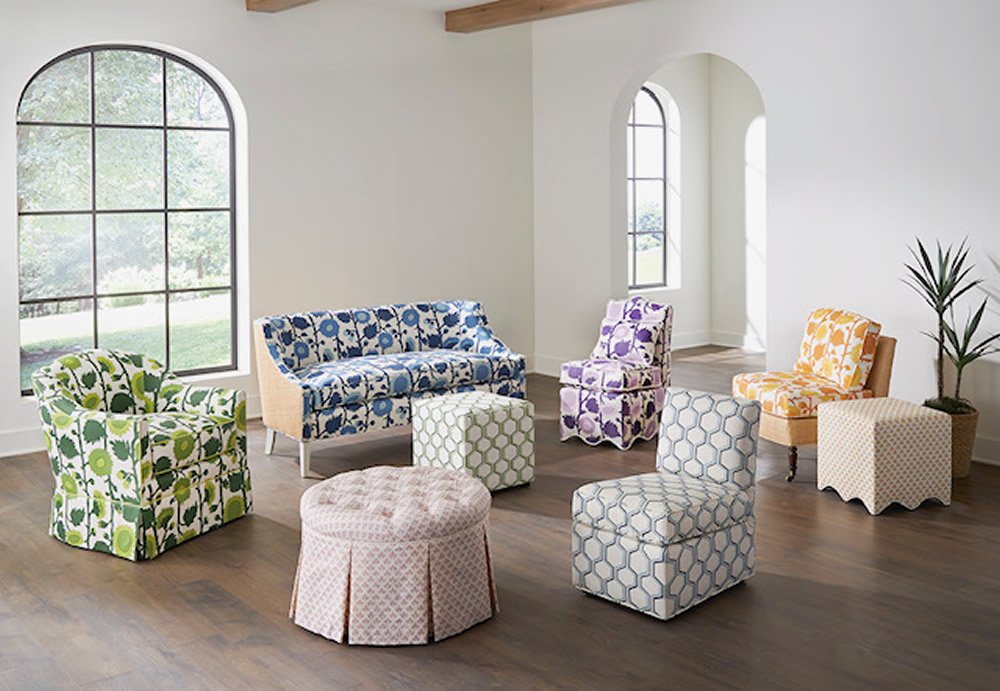
When choosing a patterned fabric, color and design are often the first details people notice. However, one technical measurement can have a major impact on how the fabric looks, how much material a project requires, and how the finished design comes together: the fabric repeat.
Understanding fabric repeat is especially important when selecting material for upholstery, drapery, pillows, headboards, and other custom applications. A large botanical print may require careful placement, while a geometric pattern may need precise alignment across seams. In both cases, the repeat helps determine how the design should be cut and matched.
This guide explains what fabric repeat means, how vertical and horizontal repeats work, why pattern matching affects yardage, and what to consider before ordering a patterned fabric.
A fabric repeat is the distance between one point in a pattern and the point where that same design begins again.
Most printed and woven patterned fabrics are created using a design that repeats at regular intervals. The repeat allows the pattern to continue across the width and length of the material.
For example, imagine a floral fabric featuring a large blue flower surrounded by leaves. If the same blue flower appears again 27 inches farther down the fabric, the vertical repeat may be 27 inches.
Fabric repeats can be small and subtle or large and dramatic. Some patterns repeat every few inches, while large-scale designs may have repeats measuring several feet.
The size and structure of the repeat influence:
Understanding the repeat before ordering helps ensure there is enough fabric to complete the project properly.
The vertical repeat measures the distance along the length of the fabric before the pattern begins again.
Fabric is generally produced and sold in a continuous length, often described as running up the roll. The vertical repeat follows this direction.
For example:
Vertical repeat: 36 inches
This means the same point in the design appears again every 36 inches along the length of the fabric.
Vertical repeat is particularly important for:
When multiple pieces are placed beside one another, additional fabric may be needed so the motifs begin at consistent positions.
For instance, matching the design across several drapery panels may require each panel to be cut according to the pattern repeat rather than simply according to the finished curtain length.
The horizontal repeat measures the distance across the width of the fabric before the pattern begins again.
For example:
Horizontal repeat: 18 inches
This means the same point in the design repeats every 18 inches from one side of the fabric to the other.
Horizontal repeat can affect:
A fabric may have several horizontal repeats across its full width, or one large design may occupy nearly the entire usable width.
Understanding the horizontal repeat helps designers and workrooms determine how motifs can be centered and aligned.
Vertical and horizontal repeats describe two different directions within the same pattern.
A fabric specification might read:
Vertical repeat: 27 inches
Horizontal repeat: 13.5 inches
This means the design repeats every 27 inches along the length of the fabric and every 13.5 inches across its width.
Both measurements are important because patterned fabric must often be aligned in more than one direction.
The vertical repeat helps determine where cuts should be made along the roll. The horizontal repeat helps determine how the design may align across seams or multiple pieces.
Patterned fabrics often require more yardage than solid fabrics because additional material may be needed to align the design.
This process is called pattern matching.
Imagine upholstering two matching dining chairs with a large floral fabric. If the central flower is positioned near the top of one chair but near the bottom of the other, the chairs may look inconsistent.
To create a balanced result, the upholsterer may adjust the cutting position so the same part of the design appears in a similar location on both chairs.
This can require extra fabric.
The amount of additional yardage depends on factors such as:
The larger the repeat, the greater the potential need for additional material.
However, repeat size alone does not determine yardage. An upholsterer, designer, or workroom should calculate the requirements for the specific project.
Pattern matching is the process of aligning a repeating design across seams, panels, cushions, or multiple pieces of furniture.
Careful pattern matching helps the design appear continuous and intentional.
For example, on an upholstered sofa, a floral stem may continue visually from the seat cushion to the front rail. On drapery, motifs may align across neighboring panels.
Pattern matching is especially noticeable with:
Some organic or abstract patterns may be more forgiving because small differences in alignment are less noticeable.
Precise patterns generally require more planning and may require additional yardage.
A straight match, sometimes called a straight-across match, occurs when the pattern aligns at the same horizontal point across adjacent fabric widths.
With a straight match, the same motifs generally appear at the same height when fabric panels are placed side by side.
Straight matches are common in:
These patterns may be relatively straightforward to align, although large repeats can still increase yardage requirements.
A half-drop repeat offsets the pattern vertically from one horizontal section to the next.
Instead of motifs aligning directly beside one another, the neighboring section is shifted by approximately half the vertical repeat.
This arrangement can create movement and make the pattern feel more natural or less grid-like.
Half-drop repeats are common in:
For example, if a fabric has a 24-inch vertical repeat, the neighboring motif may be offset by approximately 12 inches.
Half-drop patterns may require additional planning during cutting and installation because adjacent sections do not align in a simple straight line.
A brick repeat is offset horizontally in a way that resembles the arrangement of bricks in a wall.
The motifs in one row sit between the motifs in the rows above and below rather than aligning in a straight vertical column.
Brick repeats can create visual rhythm while reducing the appearance of a rigid grid.
They are often used in:
Like a half-drop repeat, a brick repeat may require careful planning when matching fabric across seams.
A random match does not require motifs to align at a specific point.
Textured designs, scattered motifs, and certain abstract patterns may allow pieces to be placed beside one another without obvious matching.
Random-match fabrics may produce less cutting waste because the fabric does not always need to be advanced to a particular point before the next piece is cut.
However, even a random pattern may benefit from thoughtful placement. Large or distinctive motifs can still create unintended visual repetition if cuts are made without considering the overall design.
Fabric repeat is an important consideration when upholstering furniture.
An upholsterer may need to determine:
On a chair, a large flower might be centered on the backrest. On a sofa, a repeating motif may need to align across several seat cushions.
Furniture with many separate components can require more fabric because each piece may need to begin at a specific point in the pattern.
The complexity of the furniture also matters. Curved backs, multiple cushions, skirts, arms, and tufting can affect pattern placement and yardage.
Pattern repeat plays an important role in custom window treatments.
When several drapery widths are joined together, the design is often matched across seams so the pattern appears continuous.
The vertical repeat can also affect the cut length of each panel.
For example, a finished drapery panel may require a certain length for the window, hems, and headings. Additional fabric may then be needed to bring each panel to the same point in the pattern.
This is sometimes called cutting to the repeat.
Large repeats can increase the amount of fabric required, particularly for:
A professional drapery workroom can calculate yardage based on the finished dimensions, fabric width, repeat, and construction style.
Decorative pillows provide an opportunity to showcase specific parts of a pattern.
A designer may choose to center:
This process is sometimes called motif placement or fussy cutting.
Centering a particular motif may require additional fabric because the desired section may not appear near the edge of the available material.
If several matching pillows are being made, more yardage may be needed so each pillow displays the same part of the design.
Alternatively, using different sections of the pattern can create coordinated pillows that feel related without being identical.
Large upholstered headboards often showcase patterned fabrics beautifully because they provide a broad, uninterrupted surface.
However, pattern placement should be considered carefully.
A designer may want to:
The fabric width, horizontal repeat, and vertical repeat all influence how the pattern can be positioned.
Large-scale fabrics can create a dramatic effect, but additional yardage may be required to achieve the desired placement.
Not necessarily.
A large repeat often increases the potential for additional yardage, but the final amount depends on the project.
A large-scale pattern may fit efficiently on a simple bench or headboard. Meanwhile, a smaller geometric pattern may require careful alignment across many cushions and seams.
Other factors include:
The best approach is to provide the fabric specifications to the upholsterer, designer, or workroom before ordering.
Some fabrics do not have a measurable decorative repeat.
Solid fabrics may be listed as:
Certain textured or irregular designs may also have no obvious repeat.
Without a pattern that needs matching, these fabrics may allow more flexible cutting and can sometimes require less additional yardage.
However, other characteristics—such as nap, pile direction, or shading—may still affect the cutting layout.
Nap refers to the directional surface of certain fabrics.
Velvet is a common example. When brushed in one direction, it may appear darker or lighter than when viewed from the opposite direction.
Even without a printed pattern repeat, fabrics with nap should generally be cut in a consistent direction.
Other fabrics may also have:
These characteristics can affect yardage because pieces may not be rotated freely during cutting.
Fabric repeat measurements are often included in:
Look for terms such as:
If the repeat is not listed, contact the fabric manufacturer, showroom, retailer, or design professional for more information.
Repeat measurements provide useful technical information, but a small sample may not show the complete design.
A large-scale pattern may extend far beyond the dimensions of a typical sample.
When evaluating a patterned fabric, consider reviewing:
These references can provide a better understanding of the pattern’s scale, spacing, movement, and overall composition.
It is also helpful to view the fabric in the room where it will be used, since lighting and surrounding colors can influence its appearance.
Before selecting a patterned fabric, consider the following:
Fabric repeat is the measurement that describes how often a pattern begins again across the length and width of a textile. Although it may appear to be a small technical detail, it can significantly influence pattern placement, yardage requirements, cutting layouts, and the final appearance of a design.
Understanding vertical repeats, horizontal repeats, straight matches, half-drop patterns, and other repeat structures can make it easier to choose the right fabric for upholstery, drapery, pillows, headboards, and custom furnishings.
Before ordering patterned fabric, review the repeat specifications, consider how the design will be positioned, and consult an interior designer, upholsterer, or professional workroom when necessary.
Thoughtful planning helps ensure that a beautiful pattern is not only selected—but used in a way that allows its design, craftsmanship, and character to shine.