



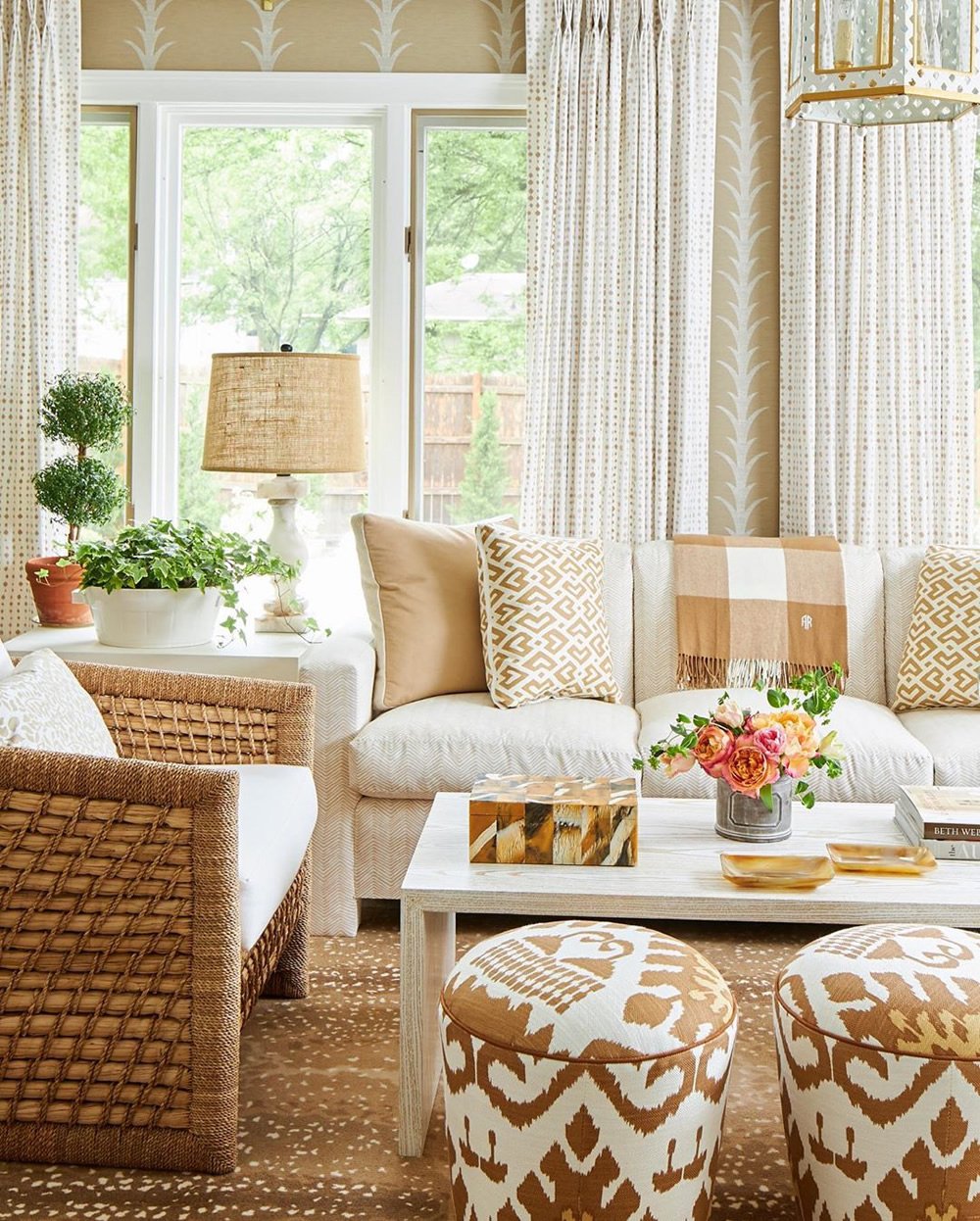
Behind every beautifully patterned fabric is a creative process that combines artistic vision, technical knowledge, and careful attention to detail. From intricate floral motifs to striking geometric prints, original fabric patterns begin as ideas that gradually evolve into decorative textiles suitable for upholstery, curtains, and other interior applications.
Although the finished fabric may appear effortless, developing an original textile design often requires extensive research, drawing, experimentation, colour development, and production testing.
For interior designers and homeowners who appreciate distinctive decorative fabrics, understanding how these patterns are created offers a fascinating look into the artistry behind textile manufacturing.
In this guide, we'll explore how designers create original fabric patterns, from the earliest sources of inspiration to the technical processes that transform artwork into finished textiles.
Fabric pattern design is the process of creating decorative artwork, motifs, and repeating arrangements intended to appear on textiles.
These designs may be printed onto fabric, woven into its construction, or produced using other textile manufacturing techniques.
Fabric patterns can incorporate many different visual elements, including flowers, leaves, geometric shapes, stripes, abstract forms, and decorative illustrations.
Unlike artwork created solely for display, textile patterns must often function across a continuous surface.
This means designers need to consider how individual motifs repeat, how colours interact, and how the finished pattern will appear when used for furniture, curtains, or other applications.
Successful fabric pattern design combines artistic creativity with an understanding of textile construction and manufacturing requirements.
The design process usually begins with inspiration.
Textile designers draw ideas from numerous sources, including nature, architecture, historical decorative arts, travel, and contemporary visual culture.
The goal is to develop a distinctive concept that can be translated into a textile pattern.
Nature has inspired textile design for centuries.
Flowers, leaves, vines, branches, and other botanical elements provide a nearly endless source of decorative possibilities.
A designer might study the shape of a particular flower, the arrangement of leaves on a branch, or the movement of climbing vines.
These observations can become the foundation for original floral or botanical patterns.
Some designers favor realistic illustrations, while others simplify natural forms into stylized motifs.
Historical fabrics can provide valuable inspiration for contemporary textile designers.
Traditional woven patterns, antique printed fabrics, embroidery, and decorative arts offer insight into established design techniques and motifs.
Designers may study historical textiles to understand their composition, colour relationships, and pattern structures.
Rather than reproducing an existing design, an original interpretation might incorporate different proportions, updated colours, or newly developed motifs.
Historical influences can be especially valuable when creating fabrics for traditional or transitional interiors.
Architecture provides another important source of inspiration.
Decorative tiles, building facades, ironwork, arches, and architectural ornamentation can all suggest interesting geometric arrangements.
A designer might transform a repeated architectural detail into a structured textile pattern.
Geometric fabric designs often rely on rhythm, symmetry, and carefully balanced proportions.
Travel can expose designers to different artistic traditions, landscapes, and decorative techniques.
Regional textiles, ceramics, architectural details, and other visual references may inspire new pattern concepts.
When working with culturally specific designs, thoughtful research and appropriate acknowledgment of their origins are important.
The objective is to develop an original artistic interpretation while respecting the traditions that inform it.
Once a source of inspiration has been identified, the designer begins developing the concept.
This stage involves exploring different visual directions before committing to a final pattern.
Mood boards help organize ideas and establish the overall character of a textile collection.
They may include photographs, colour references, drawings, historical imagery, and examples of textures or decorative details.
A mood board can help determine whether a pattern should feel bold, delicate, traditional, contemporary, or playful.
It also provides a useful reference throughout the design process.
Designers often begin by sketching individual elements that will eventually become part of the finished pattern.
These elements are known as motifs.
A floral design, for example, may begin with separate illustrations of flowers, leaves, and stems.
A geometric design might start with experiments involving lines, circles, diamonds, or other shapes.
Sketching allows designers to explore different compositions before developing the complete repeat.
The same subject can be interpreted in many different ways.
A botanical pattern might feature detailed, realistic illustrations or simplified, abstract shapes.
The designer must determine how the motifs should be represented and how they will interact.
This decision influences the overall personality of the finished fabric.
After developing the initial concept, the designer begins creating more refined artwork.
This stage transforms rough sketches into decorative elements suitable for textile production.
Many textile designers work with traditional drawing and painting techniques.
Pencil, ink, watercolor, and gouache can all be used to create original motifs.
Hand-drawn artwork may introduce subtle irregularities, expressive lines, and distinctive artistic details.
These qualities can be particularly appealing in floral, botanical, and decorative textile patterns.
Digital design tools also play an important role in modern textile development.
Designers may create artwork directly on a computer or tablet using specialized illustration software.
Digital tools allow them to adjust proportions, refine shapes, experiment with colours, and test different arrangements.
They also make it easier to develop accurate repeating patterns.
Many designers use a combination of hand-drawn and digital methods.
For example, a floral motif may begin as a watercolor painting that is later scanned and refined digitally.
The designer can then arrange the artwork into a repeating composition.
This approach preserves aspects of the original illustration while providing greater control over the technical requirements of textile production.
One of the most important stages in creating original fabric patterns is developing the repeat.
A fabric pattern repeat is the section of a design that repeats across the textile to create a continuous arrangement.
When properly constructed, the repeated sections connect without unwanted gaps or visible interruptions.
Different repeat structures create different visual effects.
A straight repeat places the design unit directly beside and below identical units.
The motifs align in regular rows and columns.
This structure is common in geometric patterns, stripes, and certain decorative prints.
Straight repeats can create a sense of order and symmetry.
In a half-drop repeat, the design shifts vertically by half the repeat height in alternating columns.
This arrangement can create a more fluid appearance and make the underlying repeat structure less obvious.
Half-drop repeats are often used for floral and botanical patterns.
A brick repeat offsets alternating rows horizontally, similar to the arrangement of bricks in a wall.
This structure can create movement and visual variety.
It may be particularly effective for smaller motifs and decorative geometric patterns.
Some fabric designs feature motifs arranged in a seemingly irregular or scattered composition.
Although these patterns may appear spontaneous, they can still rely on carefully constructed repeats.
Designers must ensure that the overall distribution feels balanced and that the repetition does not create unintended visual clusters.
Pattern scale refers to the size of the decorative motifs in relation to the fabric.
It plays an important role in determining how a design will appear in an interior.
Small-scale designs feature relatively compact motifs.
These patterns can introduce subtle texture and detail, particularly when viewed from a distance.
They are often versatile for decorative cushions, upholstered chairs, and coordinating textiles.
Medium-scale patterns provide a balance between visual interest and adaptability.
They can work well across numerous applications, including curtains, upholstery, and decorative accessories.
Large-scale designs feature prominent motifs that can create dramatic visual statements.
Oversized florals, botanical illustrations, and geometric patterns may be especially effective on expansive curtain panels or statement furniture.
However, large-scale patterns require careful consideration of placement.
A design that looks beautiful across a full fabric width may appear quite different when cut into smaller upholstery pieces.
Designers often experiment with multiple versions of the same pattern.
A floral motif might initially be developed at a large scale before being reduced to create a more delicate variation.
Testing different sizes helps determine which version best supports the intended application.
Colour development is another essential part of the textile design process.
A single fabric pattern may be offered in several colour combinations, commonly known as colourways.
Each colourway can give the same design a dramatically different personality.
Designers begin by considering the overall mood and intended use of the fabric.
Soft blues, greens, and neutrals may create a relaxed appearance, while saturated pinks, oranges, and yellows can produce a more energetic effect.
Colour selection may also be influenced by existing textile collections or the need to coordinate with other decorative fabrics.
The relationship between colours is often just as important as the individual shades.
Designers consider contrast, saturation, visual hierarchy, and the distribution of colour across the pattern.
For example, a floral print may feature a dominant background colour, several supporting shades, and a small amount of contrasting colour.
Careful colour placement helps individual motifs remain recognizable without overwhelming the overall composition.
Once the original palette has been developed, designers may experiment with alternative combinations.
A botanical print could be produced in blue and white, green and cream, or a multicoloured arrangement.
These variations allow the same pattern to complement different interior design schemes.
However, the final appearance must be evaluated on the intended fabric because textile fibers, weave structures, and printing processes can influence how colours are reproduced.
A beautiful pattern is only one component of a successful textile.
The material onto which a design is printed, or the structure into which it is woven, can significantly influence the finished result.
For printed fabrics, designers and manufacturers must select an appropriate base cloth.
Cotton is widely used in decorative textiles because of its versatility.
Depending on its weave, weight, and finishing, cotton can provide different surface textures and performance characteristics.
It can be suitable for various printed fabric applications.
Linen offers a distinctive natural texture and is frequently associated with sophisticated decorative interiors.
Its characteristic surface can influence the appearance of printed patterns.
Linen may be particularly appealing for curtains and certain upholstery applications when the specific textile meets the relevant performance requirements.
Cotton-linen blends combine characteristics of both fibers.
Depending on their construction, they may offer a balance of texture, flexibility, and structure.
These fabrics are often considered for decorative applications where both appearance and material characteristics are important.
Designers may also work with silk, wool, synthetic fibers, or specialty textile constructions.
Each material has different characteristics that can influence printing, texture, drapability, and durability.
The intended application should guide the selection of the fabric base.
Once the artwork, repeat, colours, and fabric base have been established, the design must be translated into a suitable manufacturing process.
Different printing techniques offer different advantages.
Screen printing transfers colour through selected areas of a prepared mesh screen.
For multicoloured designs, separate screens may be required for individual colours or components.
Screen printing can produce detailed decorative patterns and is used in various textile manufacturing applications.
The method can be particularly effective for designs featuring defined colour areas.
Digital printing uses specialized equipment to apply designs to textiles from digital artwork.
It can reproduce intricate details, complex colour arrangements, and designs containing subtle tonal variations.
Digital printing also allows designers to experiment with artwork without preparing traditional printing screens.
However, its suitability depends on factors such as fabric composition, ink chemistry, production volume, and desired performance.
Traditional block printing uses carved blocks to transfer decorative motifs onto fabric.
Each impression is applied individually, often by hand.
This technique can create distinctive patterns featuring subtle variations associated with the printing process.
Block printing has a long history in textile design and continues to influence contemporary decorative fabrics.
Rotary screen printing uses cylindrical screens to transfer designs onto fabric during continuous production.
It can be suitable for larger-scale manufacturing and repeating textile patterns.
The choice of printing method depends on the design's complexity, colour requirements, fabric characteristics, and production needs.
Before a design enters full production, manufacturers often create samples to evaluate how the artwork translates onto the selected textile.
One important type of sample is known as a strike-off.
A strike-off is a test printing used to assess a design's colour, detail, and overall appearance before production.
Colours may appear different on fabric than they do on a computer screen or painted illustration.
A strike-off allows designers to examine the actual printed colours under appropriate lighting conditions.
Adjustments may be necessary to achieve the intended result.
Fine lines, small motifs, and intricate decorative elements may reproduce differently depending on the printing method and fabric surface.
Sampling helps identify areas that require refinement.
In multicoloured printing, registration refers to the alignment of the different colour components.
Poor registration can cause unintended gaps or overlapping areas.
Strike-offs help manufacturers evaluate whether the design is reproducing correctly.
A fabric design may undergo several rounds of sampling before approval.
Designers may refine colours, adjust motif details, or modify technical specifications.
This stage helps ensure that the finished textile reflects the original creative vision.
An original fabric pattern must work not only as artwork but also as a practical decorative textile.
Designers consider how the pattern will appear when the fabric is cut, sewn, folded, or upholstered.
When a patterned fabric is used on furniture, the design may be interrupted by seams, cushions, and curved surfaces.
Large motifs may require careful positioning to achieve an attractive result.
For upholstery, the fabric must also meet appropriate performance requirements.
Curtains allow patterns to be displayed across relatively large surfaces.
However, folds can conceal portions of the design and change how the pattern appears.
Fabric weight, drapability, width, and pattern repeat all influence the finished window treatment.
Cushions provide an opportunity to showcase smaller portions of a pattern.
Designers may consider how motifs will be centered or positioned on individual cushion panels.
Some decorative collections include multiple patterns designed to complement one another.
A large-scale floral print might coordinate with a smaller geometric pattern or a complementary stripe.
Designers may also develop wallpaper that shares a fabric collection's colours or decorative influences.
These relationships help create cohesive interior design schemes.
After the artwork and samples have been approved, the design can move toward production.
The manufacturer must establish the technical specifications needed to reproduce the textile consistently.
These may include fabric width, pattern repeat dimensions, colour standards, printing requirements, and finishing instructions.
Quality control helps identify production issues that could affect the fabric's appearance or performance.
Depending on the product, manufacturers may evaluate colour consistency, printing accuracy, fabric defects, dimensional stability, and other relevant characteristics.
Printed fabrics may undergo additional processes after printing.
These can include drying, colour fixation, washing, or other finishing treatments.
The exact requirements depend on the textile fibers, colourants, printing technique, and intended use.
Once the fabric is ready, it may be presented through physical samples, sample books, product photography, and technical specifications.
These materials help interior designers and customers evaluate the textile before incorporating it into a project.
A successful fabric pattern combines artistic appeal with practical versatility.
Although originality is important, designers must also consider how the finished textile will function in real interiors.
Several characteristics contribute to a strong design.
Distinctive artistic identity: The pattern should have a recognizable visual character that differentiates it from other decorative textiles.
Balanced composition: Motifs should be arranged thoughtfully to create an appealing overall pattern.
Effective colour relationships: Colours should complement the design and support its intended aesthetic.
Appropriate scale: The pattern should work well for its intended decorative applications.
Technical accuracy: Repeats, registration, and manufacturing specifications must support consistent production.
Material compatibility: The design should reproduce effectively on the selected textile.
When these elements work together, the finished fabric can become both a beautiful decorative statement and a practical design material.
The time required to develop an original textile pattern varies considerably.
A relatively simple geometric design may be developed more quickly than a highly detailed botanical print requiring extensive illustration and multiple colour separations.
Other factors that influence the timeline include the number of colourways, complexity of the repeat, sampling requirements, and manufacturing method.
Some patterns may progress from concept to approved artwork relatively quickly, while more complex textile developments can require months of refinement and testing.
The creative process is rarely identical for every design.
Original fabric patterns offer interior designers opportunities to create distinctive, expressive spaces.
Rather than relying exclusively on generic decorative motifs, designers can select textiles with recognizable artistic identities.
A bold botanical print might establish the colour palette for an entire living room.
A sophisticated geometric fabric could provide contrast against traditional furniture.
A distinctive stripe may connect several decorative elements throughout a space.
Original textile designs also contribute to the broader character of an interior by introducing visual details that reflect the designer's artistic intentions.
In luxury interiors, where careful material selection and thoughtful coordination are particularly important, distinctive fabric patterns can play a central role in the finished design.
Textile designers arrange individual motifs into a repeat unit that can be reproduced continuously across fabric.
Common arrangements include straight repeats, half-drop repeats, and brick repeats.
Digital design tools can help designers test alignment and ensure the pattern connects correctly.
Both methods are widely used.
Some designers create artwork by hand, while others work digitally.
Many combine traditional illustration techniques with digital tools to refine artwork and prepare repeating patterns.
Printed patterns are applied to the surface of an existing textile using dyes, pigments, or printing pastes.
Woven patterns are created through the arrangement of yarns during fabric construction.
The two methods can produce different textures, visual effects, and performance characteristics.
A colourway is a particular colour combination used for a fabric design.
The same pattern may be produced in several colourways to suit different interior design palettes.
A strike-off is a sample printing used to evaluate how a design reproduces on fabric before full production.
It allows designers and manufacturers to review colour, pattern detail, and printing accuracy.
Yes. Some decorative patterns can be adapted for both textiles and wallpaper.
However, differences in material, printing methods, scale, and installation requirements may require adjustments to the original artwork.
At Quadrille, distinctive patterns and expressive colour combinations are central to the appeal of decorative textiles.
From sophisticated florals and botanical motifs to bold geometric designs and classic stripes, fabric patterns offer countless opportunities to introduce personality into interior spaces.
Understanding how original fabric patterns are developed provides a greater appreciation for the artistic and technical decisions behind decorative textile design.
Whether you're selecting upholstery for a statement chair, coordinating curtains with wallpaper, or developing a complete interior colour scheme, thoughtfully designed fabrics can help bring your creative vision to life.
Explore the fabric and wallpaper collections at Quadrille Fabrics to discover distinctive patterns for your next interior design project.
Creating an original fabric pattern is a process that combines inspiration, artistic experimentation, technical development, and textile manufacturing expertise.
From the first sketches to the final printed or woven fabric, designers must consider numerous details, including motif arrangement, pattern repeats, colour relationships, material selection, and production requirements.
The result is more than a decorative surface. A thoughtfully designed textile can influence the character, atmosphere, and visual identity of an entire interior.
By understanding how designers create original fabric patterns, interior designers and homeowners can develop a deeper appreciation for the creativity, craftsmanship, and technical knowledge behind the fabrics they choose.
Ultimately, the most successful textile designs bring artistic expression and practical functionality together, transforming an original idea into a beautiful material for everyday living.