



In 1974, the photographer William Eggleston showed a picture of a bare lightbulb on a red ceiling to the curator John Szarkowski at the Museum of Modern Art. Szarkowski gave him a solo exhibition - the first for color photography at MoMA - and the critical establishment revolted. The objection was not that the photographs were bad. The objection was that they were imperfect. The colors bled. The compositions were off-center. The grain showed. A machine could have done it better.
Szarkowski's response was essentially: yes, and that is the point.
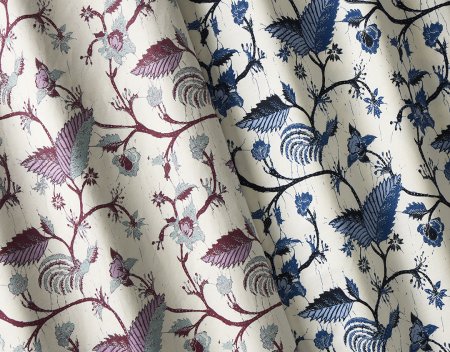
Hand screen printing on fabric operates on the same principle. Every yard that comes off the printing table at Quadrille's facility carries the irreducible evidence of a physical process: a human arm pulling a squeegee across a silk screen, ink passing through mesh at a pressure that varies - imperceptibly, but genuinely - from stroke to stroke. The color saturation at the selvage edge differs from the center by fractions that no instrument would measure but that a trained eye registers as life. Hold a digitally printed fabric next to a hand-printed one and the digital version will be more uniform, more precise, more perfectly calibrated. It will also be dead.
This is not a sentimental argument. It is a technical one. Digital textile printing deposits ink from a fixed distance onto a moving substrate using piezoelectric droplet ejection — the same technology as an office inkjet printer, scaled up. The result is a perfectly repeatable image with a color gamut determined by the CMYK or extended-gamut ink set in the machine. Every yard is identical to every other yard. The registration is flawless. The hand of the goods - the way the fabric feels between thumb and forefinger - is unchanged by the printing process because the ink sits on the surface rather than penetrating the fiber.
Screen printing is the opposite in every particular. The ink is pushed through the fabric. It becomes part of the cloth rather than sitting on top of it. This is why a China Seas linen / cotton printed at the Quadrille facility develops a patina that a digitally printed fabric cannot - the pigment is bonded into the fiber structure, not deposited on the surface like a decal. The hand improves with age. The drape softens. The colors do not crack or peel because there is no layer to crack or peel from
The process requires one screen per color. A twelve-color design requires twelve screens, each one a separate pass on the printing table. The registration - the alignment of each screen to the one before it - is done by eye using guide marks called stops. An experienced printer can register twelve colors within tolerances that would satisfy an engineer. But the registration is human, which means it carries the signature of the session: the temperature in the room (which affects ink viscosity), the humidity (which affects how quickly the previous color sets), the particular printer's rhythm and pressure. Two bolts printed on the same day from the same screens will be recognizably the same pattern in the same colorway, but they will not be identical. They are performances of the same score. AND - if one is ever tempted to "pull out all the stops" - well - you can imagine the result!
The composer Arvo Pärt once said that he could always tell when a performer had found the right tempo for his music because the notes began to "shine." The shine was not in the score. It was in the space between the intention and the execution. Hand printing operates in that same space. The width of the gap is what separates craft from manufacturing.
Consider the economics. A digital printer can produce a custom colorway in a sample length within hours. A hand printer must mix the ink to match, prepare or retrieve the screens, set up the table, proof the first strike, adjust, and print. The lead time is weeks. The cost is higher. The minimum yardage is larger. By every metric that a procurement spreadsheet measures, digital printing is superior. This is precisely the analysis that Clayton Christensen described in The Innovator's Dilemma: the new technology is cheaper, faster, and more accessible, and it will capture the low end of the market first, then move upward until the incumbents have nowhere left to stand.
Except that Christensen's framework assumes the product is substitutable — that the customer is buying a function (printed fabric) rather than a quality (the particular character of hand-printed fabric). For commodity textiles, this is true. For a designer specifying Quadrille's Bali Hai in a custom colorway for a client's Palm Beach living room, it is not. The designer is not purchasing "printed linen." The designer is purchasing the specific visual texture that hand printing produces on that specific ground cloth in that specific colorway, with the understanding that the result will have the quality that Japanese aesthetics calls wabi-sabi — the beauty of imperfection, of transience, of the mark left by the maker's hand.
There is a parallel in wine. A mass-produced Chardonnay from a temperature-controlled stainless steel tank will be technically flawless - clean, consistent, exactly the same from bottle to bottle. A Burgundy from a small domaine will vary by vintage, by barrel, by the specific parcel of vines. It will cost more. It will sometimes disappoint. But when it succeeds, it will do something that the industrial wine cannot: it will express a particular place, made by a particular person, in a particular year. The word the French use is terroir. Fabric has terroir too. The printing table at the Quadrille facility is a place. The printers are particular people. The bolt they produce on a Tuesday in March is the product of that specific convergence of material, skill, environment, and intention - and even the MUSIC blasting from the speakers as the cloth is printed. It cannot be sourced from anywhere else.
This is the argument against perfection. Not that perfection is undesirable, but that in certain applications - and residential interior design is emphatically one of them - perfection is the wrong objective. A room is not a rendering. It is inhabited by people who move through it in changing light, who touch the curtains when they draw them, who notice over years that the sofa cushion where they always sit has developed a quality that the matching chair has not. Hand-printed fabric ages into a room. Digitally printed fabric merely persists in one.
Eggleston's red ceiling is now one of the most reproduced photographs in the history of the medium. The bare bulb glows. The color bleeds. It is perfect in its imperfection. Forty years later, nobody is looking at the technically superior alternative.