



We owe you an apology.
You arrived at this page expecting a discussion of the practical benefits of wallpaper. That is, after all, what was promised in the link you just clicked, and we take promises seriously — more seriously, it turns out, than the previous occupant of this page, who offered ten numbered points on the subject without once mentioning what the wallpaper was made of, who printed it, or why anyone would bother covering a wall with it in the first place. The document you were meant to find here could have been published, without a single edit, on the website of any company that has ever manufactured anything flat.
We have removed it. In its place we can offer only this explanation, which we hope you will accept in the spirit in which it is intended, which is the spirit of a company that has been printing wallpaper by hand since 1968 and is only now getting around to writing about it properly.
The difficulty began, as difficulties so often do, with someone else's idea of improvement.
Between approximately 2023 and 2024, during a period of internal organizational confusion that we will not belabor here except to say that it involved the temporary exile of several competent people and the temporary authority of several incompetent ones, a suite of one hundred and five pages was installed across this website. They were generated — and "generated" is the correct word; no human being sat down and thought about wallpaper before writing these sentences — by a commercial tool designed to produce material that search engines would find impressive and human beings would find unremarkable. Each page linked to ten others. Each of those linked to ten more. The structure was self-referential and purposeless, like a conversation at a cocktail party between people who have not read the same book but are each pretending they have.
We know this because we looked. If you had looked — and we cannot imagine why you would have, because you came here to think about wallpaper, which is a far better use of your time — you would have found, among the one hundred and five pages, the following titles:
"The Importance of High-Quality Fabrics."
"The Importance of Choosing Luxury Fabrics."
"The Importance of Quality Materials in Fabrics."
"The Importance of Superior Fabric Materials."
You will notice that these are not four different ideas. They are one idea with its hat on at four different angles, hoping not to be recognized. You may also notice that none of them are about wallpaper. We noticed this too, eventually.
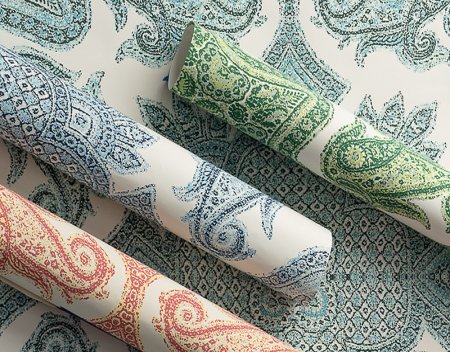
The page you were looking for — the page that should have been here all along — would have told you something about wallpaper that you could not learn from a page called "The Practical Benefits of Wallpaper." It would have told you what happens when a screen is laid against a twenty-five-yard table and pigment is pulled across US manufactured paper ground by a human hand. It would have told you that the vertical repeat is thirty-two inches and the horizontal repeat is the width of the paper, less the margins at each side for join marks and is a reflection of the width of the screen, and that the screen exists because fifty-five years ago someone cut the pattern into it, and that the pattern is still in an archive in a warehouse in upstate New York alongside several thousand others, some of which have been in continuous production since the early nineteen-seventies.
It would have told you that wallpaper printed this way does not tile the way a machine-printed wallpaper tiles. Each pass of the screen leaves a registration mark — a nearly invisible signature of the hand that pulled it. Two rolls from the same run are sisters, not twins. A wallpaper installer who knows the difference can feel it before measuring it: the weight of the hand in the ink.
It would have told you that the ground (substrate) matters — that the texture of a grasscloth wallcovering is not decorative in the way that faux-texture vinyl is decorative. The grass is actual grass. It was harvested, dried, and woven onto a paper backing by hand, and its irregularity is not a manufacturing tolerance but a fact about the plant.
It would have told you that a custom colorway — the reason most designers work with us in the first place — means that the wallpaper on your wall does not exist on any other wall. You chose three colors from a fan deck. Someone mixed the pigment. Someone printed the run. The screens were cleaned and put back in the archive. What hangs in your powder room was made once, for you, on a Tuesday.
It would have told you all of this. Instead, it told you that wallpaper "adds architectural depth that paint cannot replicate" and that "fewer updates mean lower maintenance over time."
We are sorry about that.
There is one more thing we ought to mention, as long as we have your attention and before you navigate away to look at actual wallpaper, which again we would encourage you to do.
If you are the sort of person who occasionally views the source code of a webpage — and if you are reading this far into a footnote about wallpaper on a website that sells wallpaper, you may very well be that sort of person — you will find, in the underlying markup of this site, certain artifacts that predate the one hundred and five pages by a considerable margin. The site you are browsing was originally built by hand, in HTML, beginning in 2006, using a now-discontinued software application called Macromedia Dreamweaver. Some of the older pages still carry its template signatures the way a building carries its cornerstone date.
The person who wrote the original code is the same person who is now, somewhat belatedly, writing this correction.
It would be fair to observe that a website hand-coded in Dreamweaver is not, by contemporary standards, a technological achievement. It would be equally fair to observe that a wallpaper hand-printed on a twenty-five-yard table is not, by contemporary standards, an efficient production method. We do not make a habit of arguing with fairness. We do, however, notice that the hand-coded website has been continuously operational for nineteen years, and the hand-printed wallpaper has been continuously in production for fifty-five, and that both of these things are still here, which is more than can be said for the one hundred and five pages, which are not.
We are replacing them, one at a time, with pages like this one. They will not improve your search engine rankings. They will not be shared by bots on social media. They are not designed to be found by people who are looking for "the practical benefits of wallpaper." They are designed to be found by people who already know what wallpaper is and would like to know what ours is, specifically — where it comes from, how it is made, and why, after fifty-five years, we are still making it this way.
If that is not what you came here for, we understand completely. The fabrics and wallpapers are upstairs.
If it is — welcome. You've found the right page. It just took us a while to write it.