



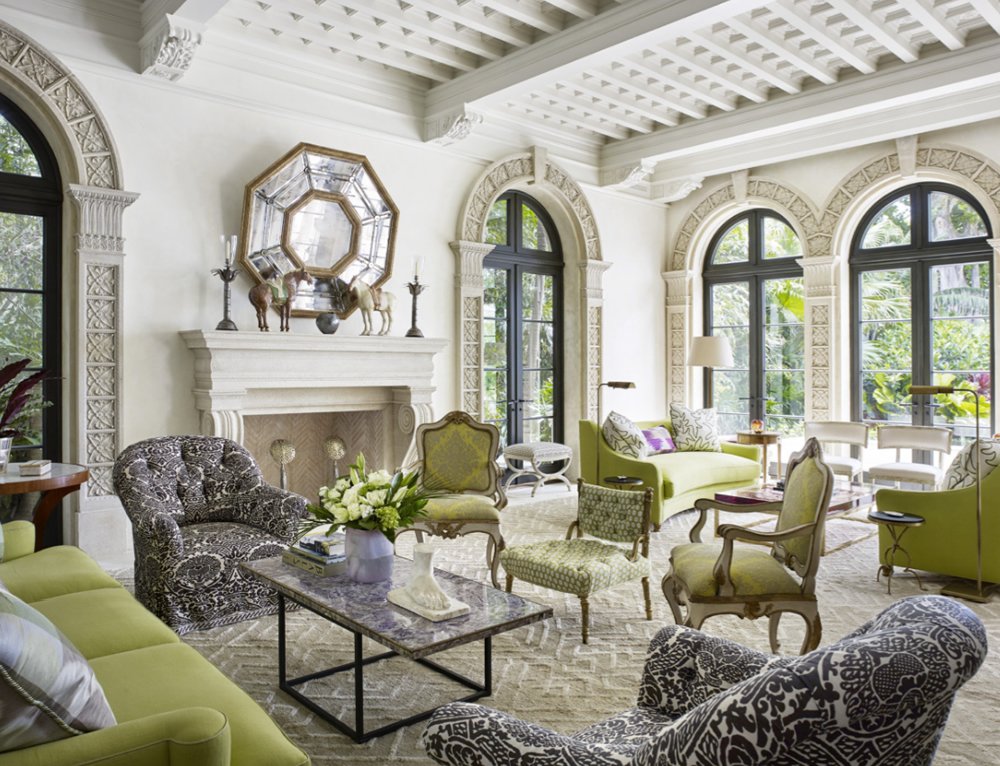
Mixing patterns is one of the most effective ways to give an interior personality, depth, and visual interest. Among the most versatile combinations is the pairing of floral and geometric fabrics.
Florals bring organic shapes, movement, and often a sense of softness to a room. Geometric patterns introduce structure, repetition, and contrast. Used together, these two very different types of fabric can create an interior that feels layered and thoughtfully designed.
The key is not making every pattern match perfectly. Instead, successful pattern mixing comes from creating relationships between color, scale, shape, and visual weight.
Here is how to mix floral and geometric fabrics with confidence.
Floral and geometric patterns work well together largely because they provide contrast.
Floral fabrics typically feature irregular, flowing forms inspired by flowers, leaves, vines, and other botanical elements. Geometric fabrics rely more heavily on repeated lines, angles, curves, grids, or shapes.
One provides organic movement while the other provides visual structure.
That contrast allows each pattern to remain distinctive instead of competing with another design that looks too similar.
A large floral paired with a simple stripe, diamond, check, or repeating geometric can therefore feel surprisingly natural.
When mixing patterns, it can help to choose one fabric as the starting point for the room.
This is sometimes called a hero fabric.
A colorful floral is particularly well suited to this role because a single design may contain several colors that can inform the rest of the interior.
Imagine a large botanical fabric containing blue, green, coral, and cream. Instead of searching for a geometric fabric containing every one of those colors, you might select a smaller geometric pattern that repeats just the blue.
The shared color creates a connection without making the two fabrics feel overly coordinated.
From there, additional solids, textures, or smaller patterns can build upon the same palette.
One of the most important principles of mixing floral and geometric fabrics is varying the scale.
Two large, visually dominant patterns placed beside each other may compete for attention. Two tiny, intricate patterns can become visually busy.
Instead, create contrast.
A large-scale floral can pair beautifully with a small or medium-scale geometric pattern. Likewise, a compact floral might work with a broader stripe or oversized geometric design.
Changing the scale makes it easier for the eye to distinguish between patterns.
The goal is to create a visual hierarchy rather than having every textile demand equal attention.
Patterns do not need to match, but they should usually have some reason for appearing together.
Color can provide that connection.
For example, a floral fabric featuring blue flowers could be paired with a blue-and-white geometric design. The patterns may be completely different, but the repeated blue creates continuity.
You can also work with related rather than identical colors.
A floral containing several shades of green may coordinate beautifully with a geometric pattern in a slightly different green. This often creates a more layered and natural appearance than attempting to match every shade exactly.
The shapes within the patterns matter too.
A flowing floral print can provide a beautiful contrast to the clean lines of a stripe, check, lattice, diamond, or other structured geometric design.
This creates a kind of visual conversation.
The floral introduces softness and movement. The geometric provides order.
If the floral is particularly elaborate, a relatively simple geometric pattern can give the eye somewhere to rest while still contributing interest.
Conversely, a restrained botanical design may be able to support a stronger geometric companion.
When comparing patterned fabrics, look beyond the motifs themselves.
The background, or ground color, can significantly influence whether two fabrics work together.
A floral on an ivory ground may naturally relate to a geometric pattern with the same warm background, even when the colors within their patterns differ.
Similarly, two patterns on crisp white grounds may feel connected because they share the same visual foundation.
Ground colors do not always need to match, but considering them can help prevent one fabric from looking unexpectedly warm, cool, bright, or muted beside another.
Successful rooms rarely require every fabric to compete for attention.
If you have chosen a spectacular floral for the curtains, for example, allow it to be the dominant pattern.
A geometric fabric might then appear on smaller elements such as:
Accent chairs
Throw pillows
Ottomans
Benches
Window seats
Decorative cushions
The opposite approach works too.
A striking geometric sofa or upholstered chair can be softened with floral pillows or nearby floral window treatments.
Giving one pattern greater prominence helps establish a clear hierarchy within the room.
Not every surface needs a pattern.
Solid fabrics can provide breathing room between florals and geometrics while reinforcing the room's color palette.
Texture can accomplish something similar.
A room might combine patterned curtains, geometric cushions, a solid sofa, and a textured upholstered ottoman. Although several materials are present, the quieter elements prevent the space from feeling overloaded.
This is particularly useful when working with colorful or large-scale designer fabrics.
A fabric combination should be considered in the context of the entire room rather than as two small swatches sitting beside each other.
The same floral and geometric pairing can feel very different depending on where each pattern appears.
A floral covering an entire sofa has significantly more visual impact than the same fabric used on a single pillow. Patterned curtains occupy a large vertical area, while an upholstered dining chair may provide only a small burst of pattern.
Think about visual proportion as well as the patterns themselves.
If one design will cover a large area, the second may only need to appear in smaller amounts to create an effective relationship.
Absolutely.
Once a floral and geometric fabric have established the main pattern relationship, another design can be introduced.
A stripe is often an effective addition because of its simplicity. A small-scale print can also work well alongside larger patterns.
For example, a room could combine:
Large floral + medium geometric + simple stripe + solid fabrics
The key is maintaining variation.
If the patterns differ in scale and structure while sharing elements of the overall color palette, the combination can feel layered rather than chaotic.
One of the easiest ways to make a room feel overly coordinated is to insist that every fabric contains exactly the same colors.
Instead, look for relationships.
Perhaps one textile repeats the floral's blue, another picks up its green, and a third introduces a complementary color.
This gives the room cohesion while allowing each textile to contribute something different.
Well-designed interiors often feel as though they have developed naturally over time rather than being assembled from a perfectly matched set.
Whenever possible, evaluate physical fabric samples in the room where they will be used.
A computer screen cannot perfectly reproduce textile color, texture, scale, or the way a material responds to light.
Place floral and geometric samples beside one another and view them alongside the room's paint, flooring, furniture, rugs, and other important materials.
It is also worth viewing them from a distance.
Two patterns that appear busy when examined inches away may feel beautifully balanced when seen from across a room.
There is no single formula for combining floral and geometric fabrics.
Some interiors call for quiet botanical patterns paired with subtle geometrics. Others benefit from fearless combinations of large-scale prints and saturated color.
The most successful combinations usually share a few characteristics: variation in pattern scale, thoughtful relationships between colors, contrast between organic and structured forms, and a clear sense of which fabric should command the most attention.
Above all, pattern mixing should create a room that feels personal.
At Quadrille Fabrics, distinctive patterns and expressive color offer countless possibilities for creating layered interiors. By combining floral and geometric fabrics thoughtfully, designers can create spaces that feel coordinated without becoming predictable—and colorful without becoming chaotic.