



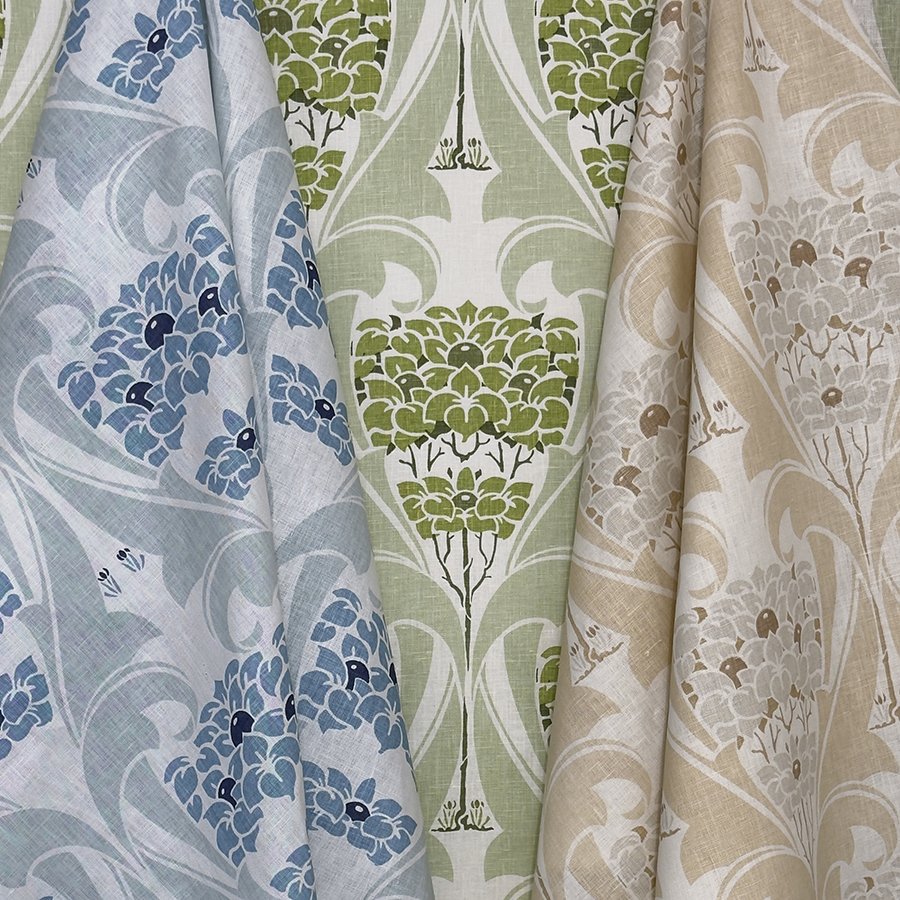
A beautiful designer fabric can appear effortless. Color, pattern, and texture come together to create a textile that simply feels right.
Behind that finished appearance, however, are numerous design and technical decisions.
From the material and ground to the pattern repeat, scale, direction, and colorway, every element contributes to how a fabric looks and how it can be used within an interior.
Understanding the anatomy of a designer fabric can make it easier to compare textiles, interpret fabric specifications, and choose the right material for upholstery, curtains, cushions, and other interior applications.
Every fabric begins with its fibers.
A textile may be made from natural fibers such as cotton or linen, synthetic fibers, or a blend of different materials. Its composition influences characteristics such as texture, appearance, weight, drape, and suitability for different applications.
Linen, for example, is appreciated for its distinctive natural character and relaxed elegance. Cotton is exceptionally versatile and provides an excellent foundation for many printed designs. Blending fibers can allow textile manufacturers to combine desirable characteristics from multiple materials.
When evaluating designer fabric, composition is therefore about much more than what appears on the surface.
It forms the foundation of the textile.
In textile design, the ground is the base fabric or background upon which a design appears.
The ground plays an enormous role in the overall appearance of a printed fabric.
Imagine the same blue botanical pattern printed once on crisp white and again on warm natural linen. Although the motif remains the same, the two fabrics may have distinctly different personalities.
Ground color can influence contrast, warmth, brightness, and how individual colors within a pattern are perceived.
The material itself also contributes texture and character that become part of the finished design.
The pattern is usually the first thing we notice about a designer fabric.
It might feature florals, botanicals, geometric shapes, stripes, abstract forms, paisleys, or other decorative motifs.
A successful pattern is more than a collection of attractive individual elements. Designers consider how those elements interact, how the eye travels across the fabric, and how the design will look when repeated over several yards.
This becomes particularly important in interior design, where a fabric may cover anything from a small cushion to a pair of floor-length curtains.
A colorway is a particular combination of colors used within a fabric design.
One pattern may be produced in several colorways. A botanical design could appear in blue and white, green and ivory, coral and pink, or an entirely different palette.
Changing the colorway can dramatically alter the personality of a pattern without changing the design itself.
A soft palette may make a bold pattern feel restrained, while saturated contrasting colors can make the same pattern considerably more dramatic.
Multiple colorways give interior designers greater flexibility when incorporating a particular design into different rooms and color schemes.
Pattern scale describes the relative size of the motifs within a design.
Some fabrics feature tiny, closely spaced elements. Others use enormous flowers, leaves, medallions, or geometric forms that stretch across a significant portion of the fabric width.
Scale influences how strongly a textile affects a room.
A large-scale pattern can become an immediate focal point, particularly when used across curtains or a substantial upholstered piece. Smaller patterns can provide detail and work beautifully alongside larger designs.
Interior designers often mix different pattern scales to create visual hierarchy and prevent multiple fabrics from competing with one another.
Most patterned fabrics repeat their design at regular intervals.
The pattern repeat describes the distance before that design begins again.
A fabric may have both a vertical and horizontal repeat depending on how the pattern is constructed.
Repeat is both an aesthetic and practical consideration. When fabric panels need to be matched across curtains, upholstery, or other applications, additional material may be required so that motifs align correctly.
Larger repeats can be especially important when calculating yardage.
Understanding the repeat before ordering helps ensure that enough fabric is available for both the project itself and any necessary pattern matching.
Some patterns have a clearly identifiable direction.
Flowers may grow upward. Animals might face a particular way. Geometric elements may flow vertically across the textile.
These are examples of directional fabrics.
Direction matters because individual sections generally need to be cut and installed consistently. Otherwise, part of an upholstered chair or curtain panel could appear upside down or visually disconnected from the rest.
Even abstract patterns can have subtle directional qualities that become apparent when viewing a larger section of material.
Direction should therefore be considered alongside pattern repeat when planning fabrication.
Fabric width is one of the most important practical specifications of a textile.
It refers to the width of the material from one side of the usable fabric to the other.
Width can affect how much material is required for a project, how curtain panels are constructed, and how upholstery pieces can be positioned.
Two visually similar fabrics with different widths may require different yardage for the same application.
This is one reason professional designers and workrooms consider technical fabric specifications before calculating final quantities.
Fabric is a tactile material, which means appearance tells only part of the story.
The term hand generally describes how a textile feels when touched—whether it feels soft, crisp, smooth, substantial, textured, or fluid.
Texture can influence the character of a fabric even when it is not immediately obvious in photographs.
This is also why physical fabric samples can be so valuable. A sample allows a designer to experience the textile's color, surface, weight, and hand rather than evaluating it exclusively through a screen.
How a textile is created is another important part of its anatomy.
Patterns can be applied or constructed through a variety of textile manufacturing and printing processes. Different methods can produce different visual qualities and levels of detail.
In printed designer textiles, the interaction between the print and its underlying ground contributes to the final appearance.
Color placement, registration, layering, and the characteristics of the base material all become part of the finished textile.
These details are part of the craftsmanship behind a fabric that may ultimately appear wonderfully simple once installed in a room.
Perhaps the most important part of understanding designer fabric is recognizing that it is designed to become something.
A swatch may eventually become a dramatic pair of curtains, an upholstered headboard, an accent chair, a Roman shade, or a collection of decorative cushions.
The intended application can change how we perceive the same textile.
A bold floral used on one small pillow may provide a touch of color. Cover an entire chair in that fabric and the pattern becomes a significant design statement. Use it across floor-length curtains and it can help establish the palette for an entire room.
This is why designers consider pattern, scale, colorway, direction, repeat, material, and placement together rather than evaluating each characteristic in isolation.
The beauty of a designer fabric lies in the way all of these individual elements come together.
Fiber provides the foundation. The ground influences the character of the textile. Pattern establishes its visual identity. Colorways reinterpret that pattern. Scale, repeat, direction, and width determine how the design behaves across a physical piece of material.
Then an interior designer, upholsterer, curtain maker, or workroom gives the fabric its final form.
At Quadrille Fabrics, textile design celebrates the relationship between color, pattern, material, and craftsmanship. Understanding the anatomy of a designer fabric makes it easier to appreciate not only how a textile looks, but also the thought and detail behind how it works within a beautifully designed interior.